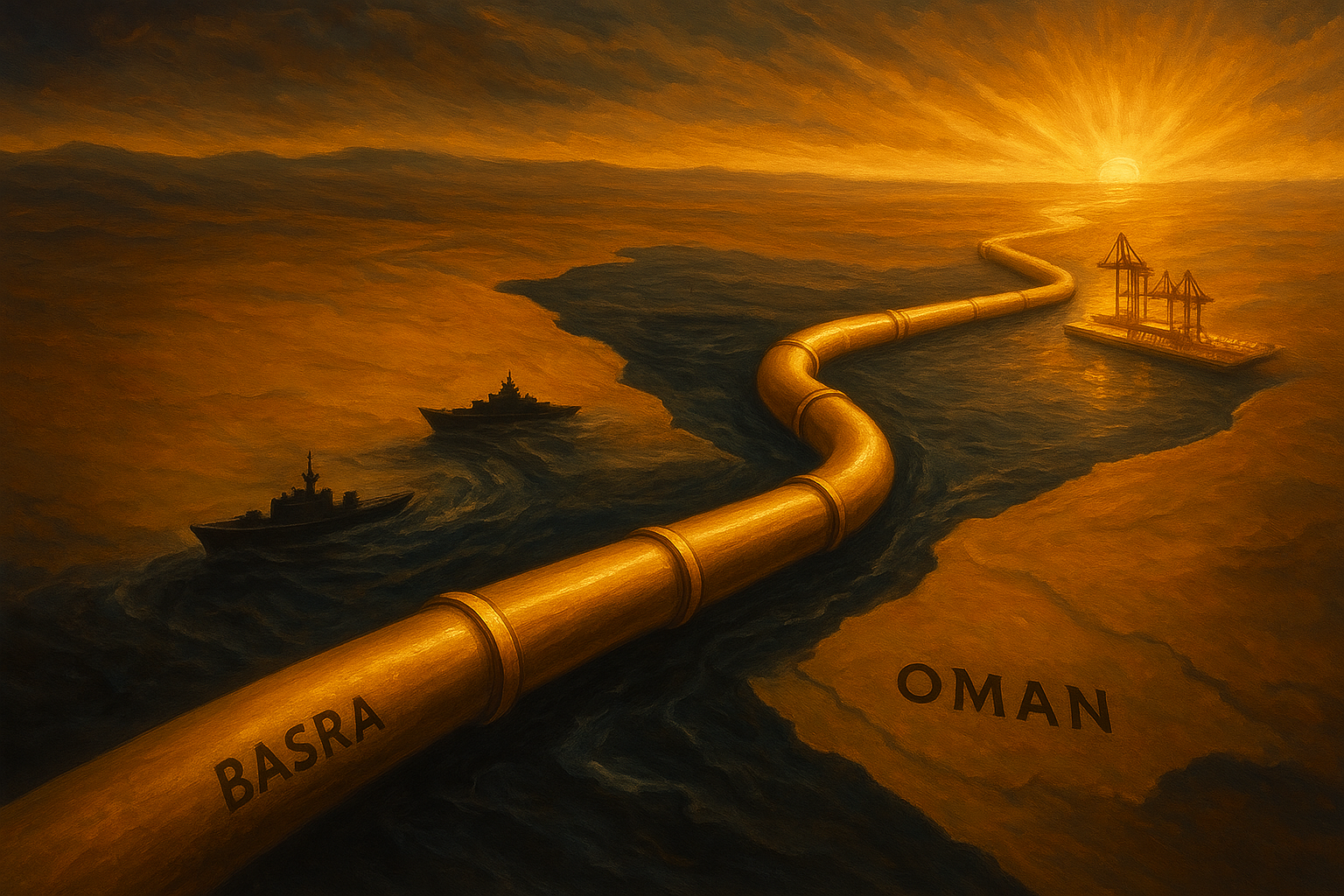
The proposed Basra-Oman pipeline is a strategic initiative by Iraq to diversify its oil export routes and reduce reliance on the Strait of Hormuz. The plan, which is still under discussion, would see a new crude oil pipeline built from Iraq’s southern city of Basra to Oman’s port of Duqm.
Reasons for the pipeline
- Diversified export routes: For years, Iraq has relied heavily on its southern ports in the Persian Gulf for the majority of its oil exports. The new pipeline would create an alternative route to the Strait of Hormuz, the world’s most important oil chokepoint.
- Reduced geopolitical risk: Geopolitical tensions, particularly threats from Iran to close the Strait of Hormuz, have spurred Iraq to seek more secure export paths. The new route would decrease Baghdad’s reliance on existing, politically fraught export routes and strengthen its independence.
- Avoid transit disruptions: The pipeline would help Iraq avoid the frequent disruptions that affect shipments from Basra. For instance, a long-running dispute with Turkey closed Iraq’s northern export pipeline in 2023, causing major financial losses.
- Access to Asian markets: Exporting crude via Oman would give Iraq better access to key Asian markets through more stable shipping routes. Oman is also expected to play a major role in marketing Iraqi oil.
- Investment and growth: The pipeline and associated infrastructure, such as storage facilities at Duqm, would support Iraq’s production growth and position Oman as an energy crossroads.
Consequences and challenges
- Political and geopolitical shift: The project is seen as a way for Iraq to reshape its energy geography and increase its bargaining power with international partners. It would also likely diminish Iran’s leverage over regional oil flows.
- High costs and financing: Building a new pipeline of this length and complexity would require billions of dollars. Analysts are skeptical of the project’s economic logic compared to closer alternatives. Iraq would need to attract significant investment, likely from Gulf or Asian sources, requiring guarantees of stability and transparency.
- Logistical challenges: The project’s immense scale and complexity present major logistical hurdles.
- Economic vs. strategic logic: The expensive and lengthy nature of the route suggests that strategic and security calculations, rather than purely commercial ones, are driving the project.
- Political centralization: Some view the pursuit of expensive alternative routes as a way for Baghdad to centralize control over oil revenues, especially following disputes with the Kurdistan Regional Government.
Proposed route options
Officials are currently weighing the feasibility of different route options for the pipeline.
- Offshore route: This would involve laying a submarine pipeline through the Arabian Gulf from the port of Basra to Oman’s coast. This option would bypass the need for transit agreements with other countries.
- Onshore route: This land-based option would require transit agreements with neighboring countries, likely including Kuwait and Saudi Arabia. An overland route could face logistical and security challenges and would depend on complex agreements with multiple nations.
- Initial phase: As an initial step before the pipeline is operational, Iraq plans to build crude oil storage tanks at Oman’s Duqm port. Crude will be transported there by tanker until the pipeline is complete.
From an engineering perspective, comparing the onshore and offshore options for the Basra-Oman pipeline reveals two fundamentally different projects, each with distinct technical challenges, costs, and specifications. The final design parameters for material, thickness, length, and diameter will depend heavily on the chosen route.
Comparison of onshore and offshore pipeline options
| Feature | Onshore Route | Offshore Route |
|---|---|---|
| Route and length | Route: Requires navigating political complexities and transit agreements with neighboring countries, such as Kuwait and Saudi Arabia. It would follow an overland path. Length: Longer and potentially more complex due to terrain and geopolitical boundaries. | Route: A subsea pipeline from the coast near Basra, traversing the Arabian Gulf to Oman. This avoids overland transit permits. Length: May be shorter and more direct, but involves significant marine engineering challenges. |
| Feasibility and cost | Feasibility: Involves standard overland pipeline construction, which is well-understood. However, land acquisition and security along the route pose substantial non-technical challenges. Cost: Generally less expensive per kilometer to construct than offshore lines but includes complex right-of-way costs and security expenses. | Feasibility: Technically complex, requiring specialized deepwater equipment and advanced installation techniques like S-lay or reel-lay. Cost: Significantly higher capital expenditure due to specialized vessels, equipment, and complex subsea tie-ins. |
| Material and specifications | Materials: Standard, API 5L carbon steel grades (e.g., X65, X70) are typically used. External corrosion protection includes coatings (e.g., 3-layer polyethylene or 3LPE) and cathodic protection. Specifications: Designed to withstand internal pressure and external stresses from burial. Wall thickness is calculated based on design pressure, material strength, and location class. | Materials: Higher-specification API 5L steel is required to withstand external hydrostatic pressure at deepwater depths. Corrosion-resistant alloys (CRAs) may be necessary in certain corrosive areas. Specifications: Design must account for hydrostatic collapse pressure, buckling during installation, and long-term fatigue loads from ocean currents. Heavier wall thickness and potentially higher-grade steel are required for deeper sections. |
| Construction and timeline | Construction: Involves land clearing, trenching, welding pipe sections, non-destructive testing (NDT), coating field joints, and backfilling. Timeline: Potentially faster construction than offshore, but heavily dependent on logistics, right-of-way issues, and secure operations along the route. | Construction: Requires a fleet of specialized pipelay vessels, offshore surveys, and remotely operated vehicles (ROVs) for subsea operations. Timeline: Can be affected by weather conditions and the availability of specialized offshore assets. |
| Operational and maintenance | Operational: Maintenance is relatively accessible but requires significant monitoring and security patrols along the route. Pipeline integrity management is critical. | Operational: Inspection and repair of subsea lines are complex and costly, requiring specialized vessels and ROVs. Maintenance: External protection relies on sacrificial anodes for cathodic protection. |
Potential pipeline dimensions
The following are estimated dimensions based on typical industry standards for long-distance, high-capacity crude oil pipelines, considering the likely transport volumes and route distances.
Length and diameter
- Length: A definitive length is not yet published, but given the geographical separation of Basra and Duqm, the route would likely be a long-distance trunkline, potentially spanning 1,000 to 1,500 kilometers or more depending on the final path.
- Diameter: The diameter is a crucial factor determining the pipeline’s capacity and operational pressure. For a major trunkline of this scale, carrying millions of barrels per day, a large diameter is necessary for efficiency.
- Possible Diameter Range: A diameter between 30 and 42 inches (762 mm to 1,067 mm) is a reasonable estimate, falling within the range of major interstate and export pipelines.
- Offshore consideration: An offshore route might require a larger diameter to compensate for the lack of intermediate pumping stations.
Material
- Likely material: High-grade carbon steel manufactured to API 5L standards would be the material of choice.
- Grade selection: The specific grade (e.g., X65 or X70) would be selected based on the required strength-to-weight ratio, which impacts both wall thickness and manufacturing cost. Higher grades allow for thinner pipe walls, which can reduce material costs, but may require more complex welding procedures.
- Environmental factors: For an offshore pipeline, the material and coatings would be chosen to resist the highly corrosive marine environment.
Key factors affecting cost
The costs for both options will be influenced by several factors:
- Geopolitics: The onshore route requires potentially complex and expensive transit agreements with Kuwait and Saudi Arabia. The offshore route avoids these but faces higher technical costs.
- Construction variables: The final cost depends heavily on the chosen diameter and length, as well as the capacity requirements.
- Inflation: Global increases in material, labor, and transportation costs will impact the final price.
- Financing: Iraq’s constrained budget and political risk profile could necessitate higher financing costs, as seen with the Basra-Aqaba pipeline, which has had fluctuating cost estimates.
Estimated cost for the onshore option
Based on a potential length of 1,000–1,500 km, and an estimated cost per kilometer, here is a general breakdown:
Assumptions:
- Cost per km: $1–2 million per km for a large-diameter pipeline under a “good rule of thumb” estimate, though it could be higher due to challenging desert terrain and logistics.
- Length (conservative estimate): 1,000 km.
- Exclusions: Excludes costs for pump stations, terminals, rights-of-way, and other related infrastructure.
Calculation:
- Base cost (low-end): 1,000 km , 1,000 km $1M/km = $1 billion
- Base cost (high-end): 1,000 km , 1,000 km $2M/km = $2 billion
With additional factors:
- Pump stations: A long-distance pipeline requires multiple pump stations, each costing potentially hundreds of millions of dollars.
- Land acquisition and permits: Negotiating land rights across international borders and navigating regulatory hurdles adds substantial, potentially unpredictable costs.
- Security: Given the regional instability, security costs for the pipeline and its operations will be significant and ongoing.
- Contingency: A large contingency fund would be required for unexpected costs and risks.
Estimated total cost (onshore):$5–10 billion, depending on final route, capacity, and security provisions. For comparison, a 1,154 km Basra-Aqaba pipeline was estimated to cost $7–9 billion, which provides a relevant benchmark.
Estimated cost for the offshore option
This route would likely follow a similar path as a previously studied Iran-Oman gas pipeline project, which involved a combination of onshore and subsea components. Based on a potential length of 1,000–1,500 km, the cost would be considerably higher.
Assumptions:
- Cost per km: The average offshore pipeline cost in the US Gulf of Mexico (pre-inflation) was roughly $1.9–2.1 million per km, with deepwater costs being significantly higher. Given the complexities of the route and depths, a higher factor is justified. A source suggests offshore pipelines can be 40–70% more expensive than onshore lines.
- Offshore multiplier: Assuming a cost of $3–4 million per km for a deepwater route.
- Length (conservative estimate): 1,000 km.
Calculation:
- Base cost (low-end): 1,000 km , 1,000 km× $3M/km = $3 billion
- Base cost (high-end): 1,000 km , 1,000 km× $4M/km = $4 billion
With additional factors:
- Deepwater engineering: Installation costs for deepwater sections are substantially higher due to specialized vessels and techniques required.
- Corrosion protection: Advanced anti-corrosion systems and heavier wall pipe materials add to the cost.
- Subsea infrastructure: Additional costs are incurred for subsea tie-ins, manifolds, and other specialized equipment.
- Terminal facilities: The offshore option would require significant investment in offshore mooring or terminal facilities in Oman.
Estimated total cost (offshore):$10–15+ billion, reflecting the substantial increase in technical and logistical complexity over the onshore route. This price could rise significantly with inflation and project-specific challenges, as seen with other offshore projects that have gone over budget.