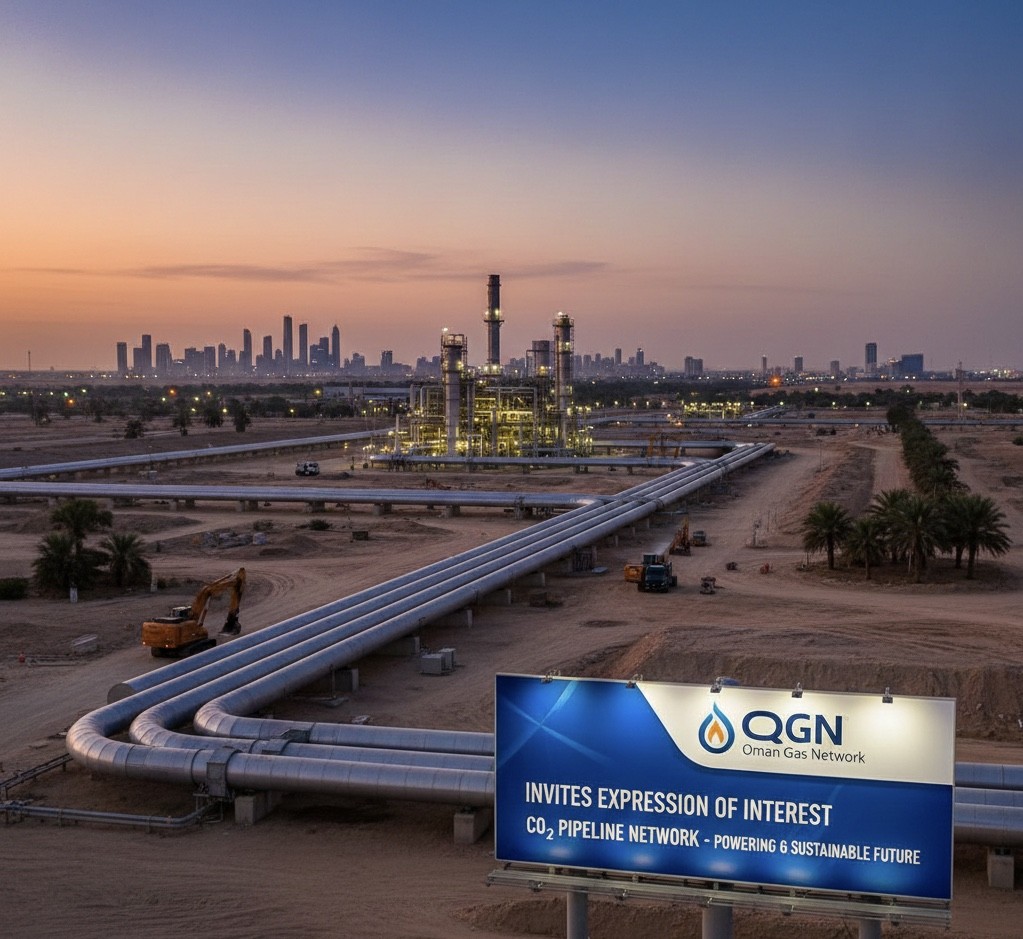
OQ Gas Networks (OQGN), a subsidiary of OQ Group, has invited local companies to submit Expressions of Interest (EoIs) for participation in developing Oman’s national CO₂ pipeline network.
In its announcement, OQGN highlighted that these EoIs will shape the design of CO₂ capture, transport, and storage infrastructure to meet real industry needs. “Aligned with national and global decarbonisation goals, OQGN is committed to building a CO₂ pipeline network that connects emission sources to storage sites, significantly reducing Oman’s carbon footprint,” the company stated.
This call follows a CO₂ transportation strategy study completed in 2024 and marks the next phase: assessing potential users’ requirements for the future network.
How to Participate
Interested companies should complete a non-binding information form, providing:
- Basic organizational details (name, location, contact information)
- Decarbonisation targets
- Planned CO₂ capture, usage, or storage (CCUS) activities
- Estimated CO₂ volumes and pipeline infrastructure needs
Strategic Importance
OQGN describes this initiative as critical for enabling industry stakeholders to contribute to infrastructure that supports their decarbonisation goals. The effort aligns with Oman’s sustainability objectives and is endorsed by the Ministry of Energy and Minerals and the Oman Net Zero Centre (ONZC)
As Oman’s designated National CO₂ Transporter, OQGN will own, operate, and maintain all CO₂ pipelines nationwide. CCUS project developers with government backing must collaborate with OQGN to ensure compatibility with the national transport network.
Planned CCUS Ecosystems
Based on last year’s market forecast, OQGN proposes three regional CCUS ecosystems:
- Northern: Serving Sohar Industrial Area (Oman’s largest emissions hub) and Ibri, with a 300 km pipeline to storage/utilization sites.
- Central: Covering Al Duqm, linked to Block 6 storage sites via a ~200 km pipeline.
- Southern: Targeting Salalah Industrial Area, connected to southern Block 6 storage through a ~300 km pipeline.
Sur was evaluated for integration into the Northern or Central ecosystems but deemed less cost-effective. OQGN is working with Sur emitters to identify closer storage solutions.
Oman’s drive to establish a national CO₂ pipeline network, spearheaded by OQ Gas Networks, presents a major opportunity for local businesses to lead in decarbonisation and sustainability. Strategic collaboration on CCUS projects, aligned with government-backed initiatives, can position investors and entrepreneurs for success in a rapidly evolving energy market. Achieving this vision will require robust infrastructure planning and seamless integration with regional emission profiles.