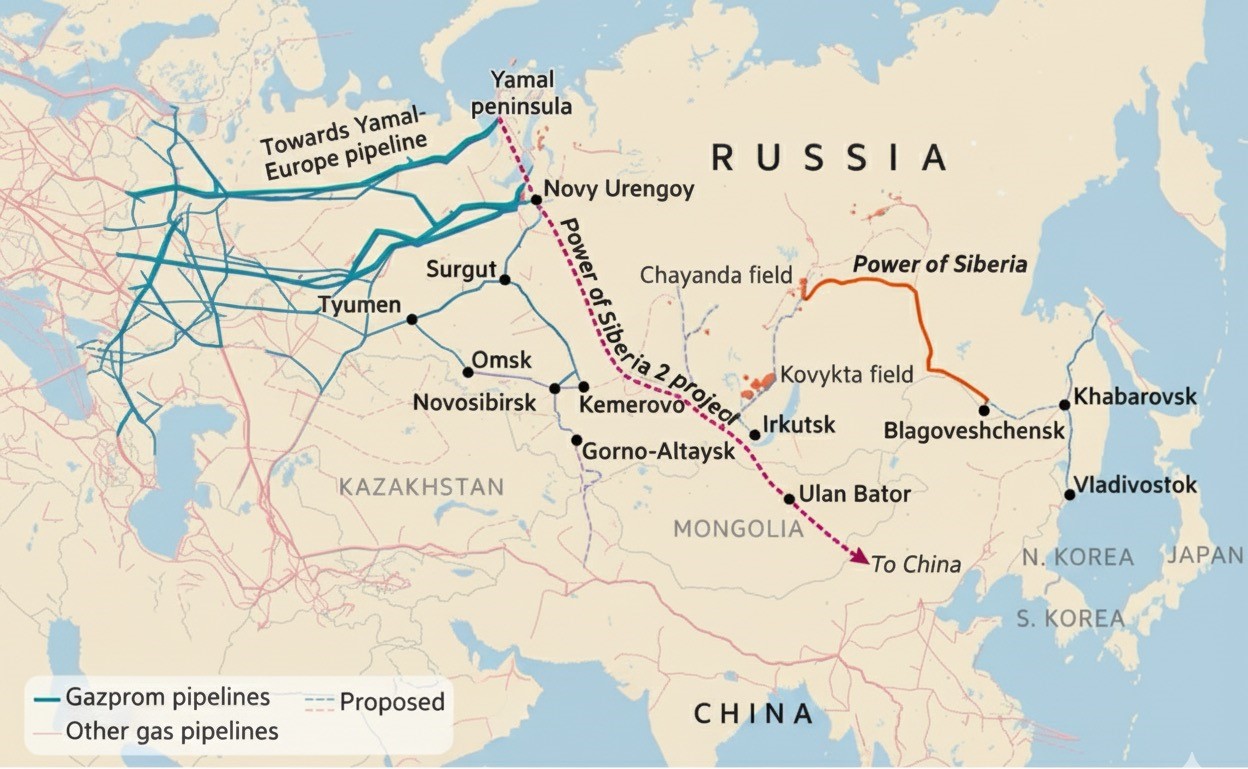
The Power of Siberia 2 (PS-2) natural gas pipeline is a proposed project aimed at transporting natural gas from Russia’s Yamal Peninsula to Northern China, primarily via Mongolia. This pipeline is planned to supplement the existing Power of Siberia 1 (PS-1) pipeline and further solidify Russia’s energy pivot towards Asia, particularly given the decline in its gas exports to Europe.
Technical specs and route
The proposed pipeline is designed to have a capacity of 50 billion cubic meters (bcm) per year, with a pipeline diameter of 1,420 mm (56 inches). The estimated length within Russia is around 2,700 kilometers. The route would traverse through various territories in Russia, including the Irkutsk Region, Buryatia, and Transbaikalia. It would then pass through Mongolia, near Ulan Bator and the Tunkinsky National Park, before entering China. The final destination in China could be Yongqing or possibly even Shanghai, connecting to the existing Chinese gas network. The route’s passage through a seismically active region near Lake Baikal presents potential technical challenges and environmental concerns.
The design and construction of PS-2 will need to address the challenging environmental conditions along its route, including extreme temperatures and seismic activity. Drawing on experience from PS-1, which crosses equally difficult terrains and operates effectively, could inform the engineering and construction decisions for PS-2. Materials chosen for the pipeline’s construction will likely possess properties to handle these challenging conditions, including specialized coatings for enhanced lifetime and internal coatings to reduce friction and improve energy efficiency. The selection of compressor stations and their placement will be crucial in ensuring the smooth and efficient flow of gas through the pipeline, as demonstrated by the existing infrastructure of PS-1.
Impact on global gas markets
If completed, PS-2, in conjunction with PS-1 and the proposed Far Eastern route, could allow Russia to increase its pipeline gas exports to China to nearly 100 bcm per year by 2030. This substantial increase in Russian gas supplies could significantly impact global gas markets by potentially reducing China’s demand for liquefied natural gas (LNG). This could lead to a global oversupply of LNG, depressing prices and affecting LNG exporters like the United States, Qatar, and Australia.
Specifically, PS-2 could:
- Dampen China’s LNG imports: China, a major LNG importer, could find itself less reliant on seaborne gas with the increase in pipeline supplies from Russia, potentially impacting LNG trade flows and prices.
- Intensify competition among LNG suppliers: With decreased demand from China, other LNG buyers could see increased leverage in negotiations, potentially driving down prices and challenging the commercial viability of high-cost LNG projects.
- Shift trade dynamics and reduce US leverage: The project could reduce US influence in global energy markets and strengthen Russia and China’s positions.
- Weaken the dollar’s dominance: The potential for a non-dollar payment mechanism for PS-2 deliveries could undermine the dominance of the US dollar in global energy transactions.
Despite the potential impacts, the PS-2 project faces several challenges and uncertainties. Negotiations on pricing, financing, and a detailed construction timeline are still ongoing. China’s growing domestic gas production, coupled with its focus on expanding renewable energy sources, could limit its future demand for imported gas, impacting the commercial viability of PS-2. Moreover, geopolitical considerations, such as China’s potential over-reliance on a single supplier and alternative import options, could further complicate the project’s future. Furthermore, environmental concerns associated with the pipeline’s route through sensitive ecosystems and potential seismic activity also present challenges that will require careful consideration and mitigation strategies.